
In The Road to El Dorado: The game of the gods, Miguel and Tulio played this game against Chief Tannabok's 15 Warriors. The Game is played with a hard rubber ball (remember these balls were of solid rubber...think the consistancy of a car tire.) And had to be knocked into a vertical hoop high above the players. In the Ancient Religion: The Gods played with human skulls. In Real Life: I had the oppertunity to visit two very different ball courts. The court at Chichen Itza was very much like the one in the movie. Large in scale had vertical walls holding up the very high hoops. It was built during the 16th century when the Mayans, Aztecs, and other smaller local tribes had merged into one and it refelected the mixed culture. This was the style of ball court that the Conquistadors saw. Interested in seeing this game played? This game is still played in many parts of mexico and central america for tourists You can find some videos on Youtube. |


The Real El Dorado |
So, what did the Spanish find in 1519 Mexico? I may not be able to show you what the Spanish found almost 500 years ago but I can show you what these places look like today. Here, you will find images from my trip to the Yucatan Pennisula and Cancun in Mexico compared with screen shots from the movie. Obviously a big thanks goes to my boyfriend Alex who wanted to take me there. These pictures were taken at mostly Chichen Itza and Coba some were also taken in the jungle. I took the large majority of pictures, some has been taken from the internet or brochures because while at Chichen Itza tempatures reached near 110 degrees, and me being used to cold northeastern US climate (and having fairer skin than most of my European ansestors) couldn't stand very long to take as many pictures as I would have liked. Chichen Itza is one of the most famous archeological areas in Mexico. The buildings there are dated to the late 15th early 16th century, the time when the Spanish arrived and when the time period of when The Road to El Dorado took place. Coba is a much older displyaing pure Mayan architecture instead of the later mixed culture of Chichen Itza. Coba is still being excavated by archelologists today. |
The Cenote Well: (Pronounced See- No- Tay) |
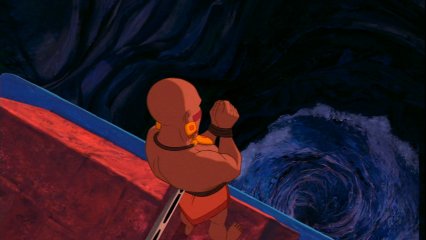
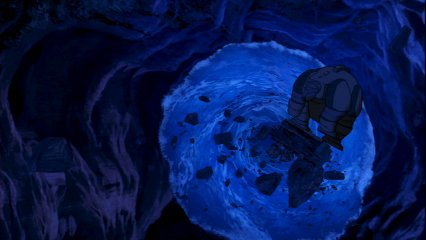
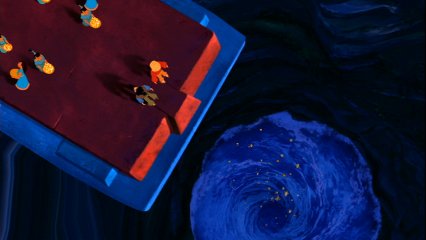
In The Road To El Dorado: The Cenote well is the entrance to Xibalba the spirit world. Tzekel-kan sends his sacrifices down the well of El Dorado in hopes of appeasing the gods. Later Tzekel-kan falls into the well and is tossed about through a series of currents out of El Dorado and to the feet of Cortez. In the Ancient Religion: Like in El Dorado the ancient mayans belived these wells to be the entrance to Xibalba, In Real Life: These natural formed wells were very improtant to not only the ancient religions of Mexico but to the very survival of the people. These underground river systems can be found all over Mexico, it is the largest underground river system in the world. The water comes from the ocean and rain water but because of the large amounts of limestone and calcium under Mexico the salt and impurities get filtered out of the water to supply the people, plants, and animals of the rainforrest with fresh water. The closer you are to the coast the more salt you will find in this water. Today many of the Cenotes are opened up for tourists to swim in, Others are still used as the main water supply, and others are used for neither, either because of natural or unnatural pollutions (because some of them appear out of ground or without natural covering from the elements.) And others are just too difficult to tap into. Either way these facinating natural wells all connect to each other and run from the east to west coast of the country. Many remain unexplored. |
The brim of the well at Chichen Itza, jut to show how massive these natural wells are, I couldn't get it all in one shot. (sacrifices were most likely made by the priest standing on the outcropping on the left side of the picture.) |
View of outcropping. |
The waters that led to Xibalba below. This well is pretty dirty mostly because it has lost it's roof a long time ago. The roof probably hasn't been there since before the Mayans lived in this particular area. Remains of humans as well as golden artifacts have been found at the bottom of this well. |
This was inside another cenote that hadn't lost it's roof and therefore provided fresh, clean, drinkable water that was very refreshing to swim in. Water is about 15-20 feet deep and we had to climb down stairs backwards to get inside the cave. (My BF and I are the third and fourth faces from the left.) |

The Ball Court |
In The Road to El Dorado: The game of the gods, Miguel and Tulio played this game against Chief Tannabok's 15 Warriors. The Game is played with a hard rubber ball (remember these balls were of solid rubber...think the consistancy of a car tire.) And had to be knocked into a vertical hoop high above the players. In the Ancient Religion: The Gods played with human skulls. In Real Life: I had the oppertunity to visit two very different ball courts. The court at Chichen Itza was very much like the one in the movie. Large in scale had vertical walls holding up the very high hoops. It was built during the 16th century when the Mayans, Aztecs, and other smaller local tribes had merged into one and it refelected the mixed culture. This was the style of ball court that the Conquistadors saw. Interested in seeing this game played? This game is still played in many parts of mexico and central america for tourists You can find some videos on Youtube. |
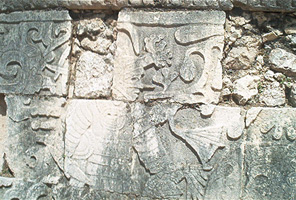
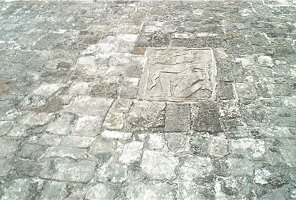
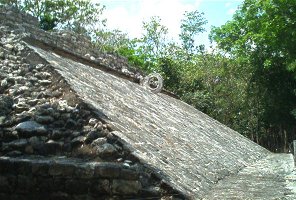
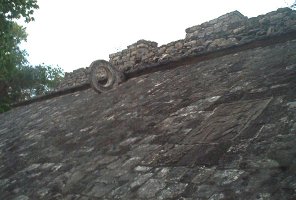
The Ball Court at Coba: this is pure mayan design with sloped walls. This was actually pretty small, there was only about 10-20 feet in between the base of the two walls. |
Another angle of the ball court hoop you can also see a carving of the god of fertility on the wall. |
A closeup of the Coba carving |
Carving on the wall at Chichen Itza |
